

If you’ve been charged with possession for sale in Southwest Riverside County, your case will be prosecuted at the Southwest Justice Center in Murrieta — and the direct answer to the question that brought you here is: almost always yes, it’s a felony, but which felony depends on the drug, and whether it stays a felony is exactly what the defense fight is about. Possession for sale of narcotics or methamphetamine is a straight felony — not a wobbler, so no judge can simply reclassify it. But the charge itself can be attacked and negotiated down, and that matters more here than in almost any other drug case, because the line between “possession for sale” and “simple possession” is also the line between jail exposure and treatment-based paths that can end with no conviction at all.
Our office has defended drug cases at the Southwest Justice Center since 1999, representing clients from Lake Elsinore, Wildomar, and French Valley, along with Murrieta, Temecula, Menifee, Winchester, and Canyon Lake — our entire Southwest Riverside County service area. If you’re facing a possession for sale charge, call (951) 400-4357 before your first court date.
The Direct Answer Depends on the Drug
“Possession for sale” is not one statute, and the felony question has three different answers:
- Narcotics — Health & Safety Code § 11351. Cocaine, heroin, fentanyl, and most prescription opioids. A straight felony: 2, 3, or 4 years and a fine up to $20,000.
- Methamphetamine — Health & Safety Code § 11378. The charge we see most often at the Southwest Justice Center, and it runs under a different statute with a different sentencing range: 16 months, 2, or 3 years. Still a straight felony.
- Marijuana — Health & Safety Code § 11359. The exception most pages get wrong: since Proposition 64, marijuana possession for sale is a misdemeanor for most defendants, with felony treatment reserved for specific circumstances such as qualifying priors or sales involving minors.
So if your charge involves narcotics or meth, you’re facing a felony as filed — and the strategy is about what it becomes, not what it’s labeled today.
What the Prosecution Has to Prove
A conviction requires proof beyond a reasonable doubt that you possessed the substance, knew it was there and knew its nature as a controlled substance, in a usable amount — and, the element that defines the charge, that you possessed it with the specific intent to sell it. No actual sale is required. No buyer is required.
Because nobody can see intent, these cases are built on inference: quantity, packaging, scales, cash, multiple phones, text messages, and the absence of use paraphernalia — usually stitched together by a narcotics officer testifying that it all “looks like sales.” Every one of those inferences can be contested, and the same facts often tell a personal-use story: heavy users buy in quantity because it’s cheaper, keep cash because they don’t bank, and own a scale to avoid being cheated. How prosecutors build — and lose — the intent element is covered in depth through our possession for sale defense practice; what matters here is that intent is the entire distance between this felony and a charge with far softer landings.
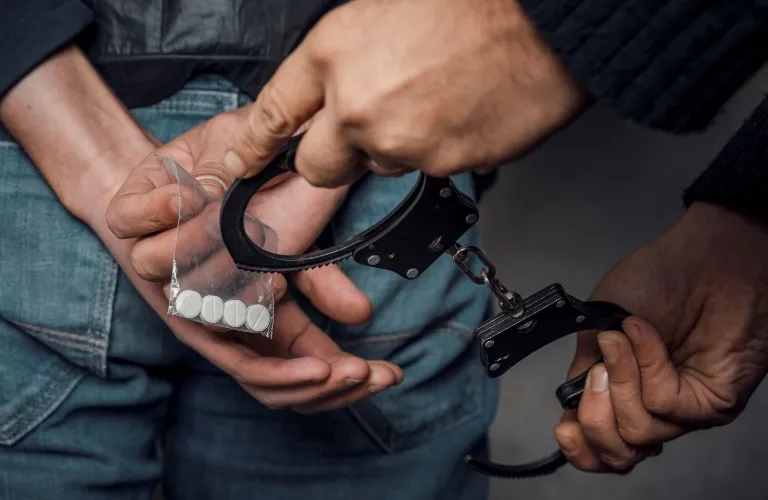
What the Prosecution Has to Prove
A conviction requires proof beyond a reasonable doubt that you possessed the substance, knew it was there and knew its nature as a controlled substance, in a usable amount — and, the element that defines the charge, that you possessed it with the specific intent to sell it. No actual sale is required. No buyer is required.
Because nobody can see intent, these cases are built on inference: quantity, packaging, scales, cash, multiple phones, text messages, and the absence of use paraphernalia — usually stitched together by a narcotics officer testifying that it all “looks like sales.” Every one of those inferences can be contested, and the same facts often tell a personal-use story: heavy users buy in quantity because it’s cheaper, keep cash because they don’t bank, and own a scale to avoid being cheated. How prosecutors build — and lose — the intent element is covered in depth through our possession for sale defense practice; what matters here is that intent is the entire distance between this felony and a charge with far softer landings.
Penalties, Enhancements, and the Fentanyl Escalation
Beyond the base terms, three things can move a possession for sale case from serious to severe:
- Weight enhancements. Under Health & Safety Code § 11370.4, kilogram-scale quantities of heroin, cocaine, or fentanyl add years — from 3 to as many as 25 — on top of the base sentence. Cases at that scale also draw federal interest; our federal crimes practice covers when a state case becomes a federal one.
- Priors. Prior drug sales convictions restrict probation eligibility and raise the realistic sentencing range.
- Fentanyl, post-Proposition 36. Since the end of 2024, California has moved sharply against fentanyl sales: enhanced treatment of fentanyl cases, and a formal court admonition to anyone convicted of dealing — a warning, on the record, that if you deal again and someone dies, you can be prosecuted for murder. If your case involves fentanyl, even mixed or trace amounts in other drugs, the DA’s posture will be different, and your defense needs to account for it from the first appearance.
Probation remains possible in many § 11351 and § 11378 cases without disqualifying priors — which is one reason the mitigation and negotiation work matters.
What a Sales Charge Cuts Off — and Why Reduction Is the Whole Game
Here is the practical difference that the charge level controls, and the reason we fight the “for sale” designation so hard:
Diversion doesn’t apply to sales charges. California’s treatment-based paths — PC 1000 pretrial diversion, drug court — are built for simple possession. Complete the program, and the case can end with no conviction. Those doors are closed to a possession for sale charge. But negotiate or litigate the charge down to simple possession, and they reopen. That single reclassification can be the difference between a felony record with jail exposure and a dismissed case after treatment. It’s the central objective in a large share of the possession for sale cases we defend, and it’s won with exactly the intent-evidence work described above, plus mitigation showing the personal-use reality of the case.
Immigration consequences are as serious as they get. For non-citizens, a drug sales conviction is treated as an aggravated felony under federal immigration law — near-automatic removal exposure, with almost no discretionary relief. If you are not a U.S. citizen, your plea strategy must be built around this from day one, not discovered after.
A felony sales conviction follows you — employment, housing, professional licensing, firearm rights — in ways simple possession doesn’t.
How These Cases Get Fought
The two battlegrounds, in order of leverage:
- The search. Possession for sale cases begin with a stop, a search, or a warrant — a traffic stop on the I-15, a probation compliance check, a raid. If the stop was pretextual beyond what the law allows, the search exceeded its scope, or the warrant was defective, the evidence can be suppressed and the case collapses. We walk through how that works in our guide to what happens when authorities make mistakes in drug cases.
- The intent inference. Attacking the sales indicia piece by piece — the quantity consistent with heavy use, the innocent explanation for the cash, the expert’s opinion built on assumptions rather than evidence.
Both depend on speed: dashcam and bodycam footage, dispatch records, and phone extractions all need to be demanded early.
Possession for Sale Cases at the Southwest Justice Center
Two local realities shape these cases. First, a large share of Southwest Riverside County drug arrests come off the I-15 corridor and the surface streets feeding it — traffic stops that become searches — which is why the suppression analysis is the first thing we examine in nearly every file. Second, felony drug cases here run through the settlement track at the Southwest Justice Center, where the charge-reduction negotiation (sale down to simple possession, felony down to a treatment-eligible case) happens — and where our office has been appearing on drug cases since 1999. The DA’s filing decision is not the last word on what your case is.
Frequently Asked Questions
Is drug possession for sale ever a misdemeanor? For marijuana, usually yes under § 11359. For narcotics and meth, no — § 11351 and § 11378 are straight felonies. The misdemeanor path in those cases runs through reducing the charge to simple possession, not reclassifying the sales charge.
Can I get diversion or drug court on a possession for sale charge? Not on the sales charge itself — diversion is for simple possession. That’s precisely why contesting the “for sale” element is the core of the defense: reduce the charge, and treatment-based dismissal paths reopen.
Does having a large quantity automatically mean intent to sell? No. Quantity is one factor among many, and the law requires the totality of circumstances. Heavy personal use explains a great deal of what prosecutors call sales indicia.
What if the drugs weren’t mine? Possession requires knowledge and control. Drugs in a shared car, apartment, or bag raise genuine possession defenses — being near drugs is not possessing them.
The Charge Is a Felony. The Outcome Is Not Decided.
A possession for sale filing is the DA’s opening position, built on inferences that can be challenged and evidence that may not survive a suppression motion. What it becomes — a reduced charge with a treatment path, a negotiated outcome, a dismissal — depends on defense work that starts now. Call the Law Office of Nic Cocis at (951) 400-4357 for a free, confidential consultation.
