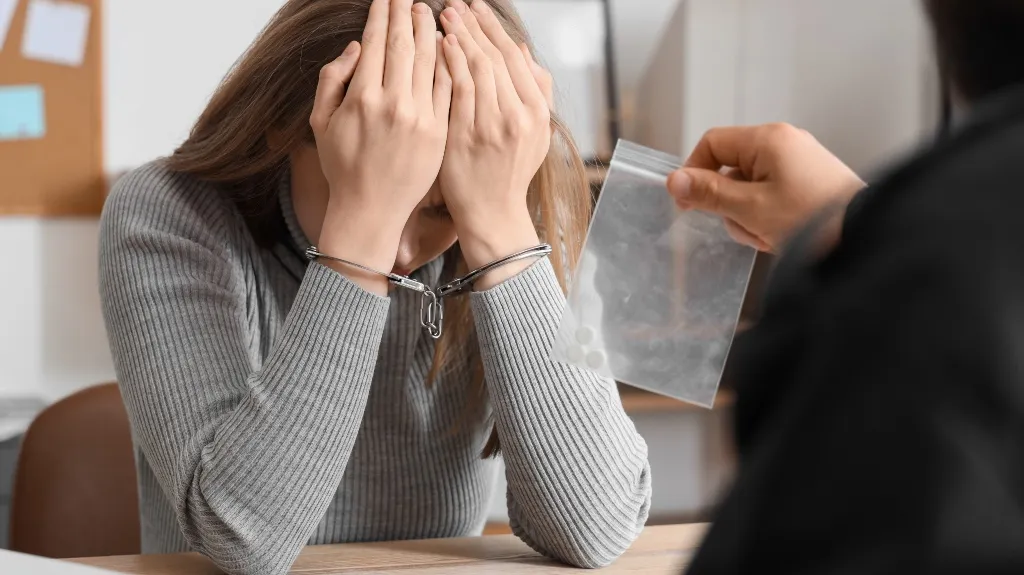
A prescription fraud charge often starts in an ordinary place — a pharmacy counter, where a pharmacist calls a doctor’s office to verify a prescription and is told it was never written. What follows is not treated as a minor drug case. California prosecutes forging, altering, or fraudulently obtaining a prescription as a serious offense in its own right — separate from, and often more serious than, simple drug possession. If you’re facing one of these charges, you may not think of yourself as a criminal at all; many people in your position developed a dependence on prescription medication and made a decision they deeply regret. The law charges the conduct the same way regardless — but that does not mean your situation is hopeless, and it does not mean jail is the only road open to you. If you or someone in your family is facing a prescription fraud or forgery charge in Murrieta, Temecula, Menifee, Lake Elsinore, Wildomar, Winchester, Canyon Lake, or French Valley, a Murrieta prescription fraud attorney can begin working on the outcome that matters most to you — usually treatment instead of incarceration — from your very first court date.
These cases are filed at the Southwest Justice Center on Auld Road in Murrieta and prosecuted by the Riverside County District Attorney.
What California Charges as Prescription Fraud
Your case may be charged under one or more of several statutes — a single incident often draws more than one. The main ones are:
- Health & Safety Code § 11368 — forging or altering a prescription, or issuing, passing, or possessing a forged or altered prescription, for a narcotic controlled substance. This is the statute behind most “prescription forgery” arrests, and if you were stopped at or after a pharmacy visit, it’s almost certainly the charge you’re facing. It reaches a wide range of conduct: writing a fake prescription, altering the quantity or refills on a real one, using a stolen prescription pad, or presenting any of these at a pharmacy. You can read the statute at Health & Safety Code § 11368.
- Health & Safety Code § 11173 — obtaining or attempting to obtain a controlled substance, or procuring its administration, by fraud, deceit, misrepresentation, or subterfuge — or by concealing a material fact, which is the “doctor-shopping” provision used when a person obtains overlapping prescriptions from multiple practitioners without disclosing the others. See Health & Safety Code § 11173.
- Health & Safety Code § 11375 — covers fraud and possession involving certain non-narcotic prescription drugs (for example, specified sedatives and stimulants), which is how the prosecution reaches medications that fall outside the narcotic definition of § 11368.
Most of these are wobblers — meaning the Riverside County District Attorney decides whether to file your case as a misdemeanor or a felony. That single decision often matters more to your life than anything that happens afterward, which is why getting an attorney involved before it’s made can be so important.
Why Prescription Forgery Is Treated as More Than “Simple Possession”
This is the single most important thing for you to understand, because it controls what help is available to you. A prescription fraud charge under § 11368 is not a simple drug possession offense — even if the only reason you forged or altered a prescription was to get medication you felt you needed. The law treats it as a fraud-and-integrity offense: it targets the act of corrupting the prescription system — deceiving a pharmacist, counterfeiting a doctor’s authority to prescribe, undermining the controlled-supply chain — not just the pills in your possession at the end of it.
That distinction has a direct, practical consequence for you. The diversion program built for simple drug possession — Penal Code § 1000 pretrial diversion — is limited by statute to specified possession offenses, and a § 11368 forgery charge generally falls outside it. The old “Proposition 36” drug-treatment program you might expect to fall back on does not reach a prescription forgery charge either — and, as explained in the next section, that program is no longer the live route it once was. The good news is that it is not your only path to treatment, and the routes that remain are often a better fit for your case.
Diversion and Treatment: the Question That Actually Decides These Cases
If your charge grew out of a real dependence — as many do — the question that matters most to your future usually isn’t “guilty or not guilty.” It’s whether your case can be resolved through treatment instead of custody. The law on how to get there has changed in recent years, and getting the current rules right is exactly where a defense attorney earns their keep.
You may have heard of “Prop 36” as a way to get treatment instead of jail, so it’s worth clearing up, because the term now causes real confusion. The original Proposition 36 (2000) treatment-instead-of-jail program is largely defunct and is no longer the live route it once was. To make matters more confusing, “Prop 36” today usually refers to a different, 2024 measure that actually increases penalties for certain repeat drug offenses — the opposite of treatment relief. So if anyone points you toward “Prop 36” to get treatment, that advice is out of date. The paths that can actually get you treatment today are:
- Penal Code § 1001.95 — misdemeanor judicial diversion. If your case is charged or reduced to a misdemeanor, a judge can grant you diversion — over the prosecution’s objection if necessary — for up to 24 months, and when you complete it the charge is dismissed and your arrest is treated as never having happened. Prescription fraud is not on the statute’s exclusion list, so a misdemeanor § 11368 charge is eligible. This is frequently the most powerful tool available to you, which is one more reason keeping your case on the misdemeanor track matters so much.
- Penal Code § 1001.36 — mental health diversion, which can apply if a qualifying mental-health or substance-use condition is connected to your offense.
- Negotiated treatment dispositions. Even outside a formal diversion statute, we have repeatedly persuaded Riverside County prosecutors to let our clients complete a structured treatment program in exchange for a reduced charge or a dismissal — the kind of outcome that depends on knowing the assigned deputy and the local drug-court resources.
Our broader discussion of pretrial diversion in Riverside County and of treatment-court dispositions for drug charges explains how these programs work in practice.
Penalties
Your exposure depends entirely on the wobbler decision:
- As a misdemeanor, you face up to one year in county jail, plus fines and probation — and, critically, eligibility for the § 1001.95 diversion described above.
- As a felony, you face 16 months, two years, or three years under California’s realignment rules.
There are also collateral consequences that can outweigh the criminal sentence itself. If you hold a professional license — as a nurse, physician, pharmacist, or in another regulated field — a prescription fraud conviction is among the most serious charges your licensing board can see, because it goes directly to professional integrity and the handling of controlled substances. And for anyone, a fraud conviction can affect your employment and your immigration status. These stakes are a large part of why the charging-tier fight comes first.
Defenses to a Prescription Fraud Charge
The right defense depends on your facts, but several come up again and again:
- Lack of knowledge or intent. Fraud and forgery require a knowing, intentional act. If you presented a prescription without knowing it had been altered, or you reasonably believed you had a valid relationship with the prescriber, you lack the intent the statute requires.
- Insufficient proof of forgery or fraud. The prosecution has to prove the prescription was actually forged or fraudulently obtained — and that you are the one who did it. Gaps in the pharmacy’s records, the verification call, or the chain of custody can undercut that proof.
- Mistaken identity — especially where a prescription was called or faxed in and identifying who actually did it is far from certain.
- Unlawful search and seizure. These investigations frequently involve searches of your person, vehicle, phone, or home. If a search was unlawful, the evidence may be thrown out — the mechanics of which we cover in our discussion of what happens when the authorities make mistakes in a search.
Related Charges
Prescription fraud sits at the intersection of two areas of law, and your case may touch both:
- General forgery of non-prescription documents — checks, IDs, signatures — is charged under a different statute (Penal Code § 470) and handled through our forgery practice.
- Large-scale or organized prescription fraud — schemes involving multiple patients, providers, or pharmacies, or conduct crossing state lines — can draw federal attention under the Controlled Substances Act. Our federal crimes practice covers that exposure. If your case is a single-defendant matter, though, it will most likely stay in state court at the SWJC, alongside the rest of the drug crimes we defend.
Why a Southwest Riverside County Prescription Fraud Attorney Matters Early
In a prescription fraud case, the early decisions quietly determine where you end up: whether your wobbler is filed as a felony or a misdemeanor, whether the door to § 1001.95 diversion stays open for you, and whether your case is presented to prosecutors as an addiction issue that treatment can resolve rather than a fraud to be punished. Once you enter a felony plea, those options narrow sharply.
The Law Office of Nic Cocis has defended drug and fraud charges throughout Murrieta, Temecula, Menifee, Lake Elsinore, Wildomar, Winchester, Canyon Lake, and French Valley for more than 25 years, appearing at the Southwest Justice Center on a near-weekly basis since 1999. We understand how the Riverside County District Attorney’s office approaches these filings, how the local drug-court and diversion options actually work, and how to present your case so that — if you are struggling with dependence — you get treatment instead of a record that follows you for life. You can read more about the firm or review our case results. If you’ve been arrested for prescription fraud or forgery, contact our office or call (951) 400-4357 for a free, confidential consultation.