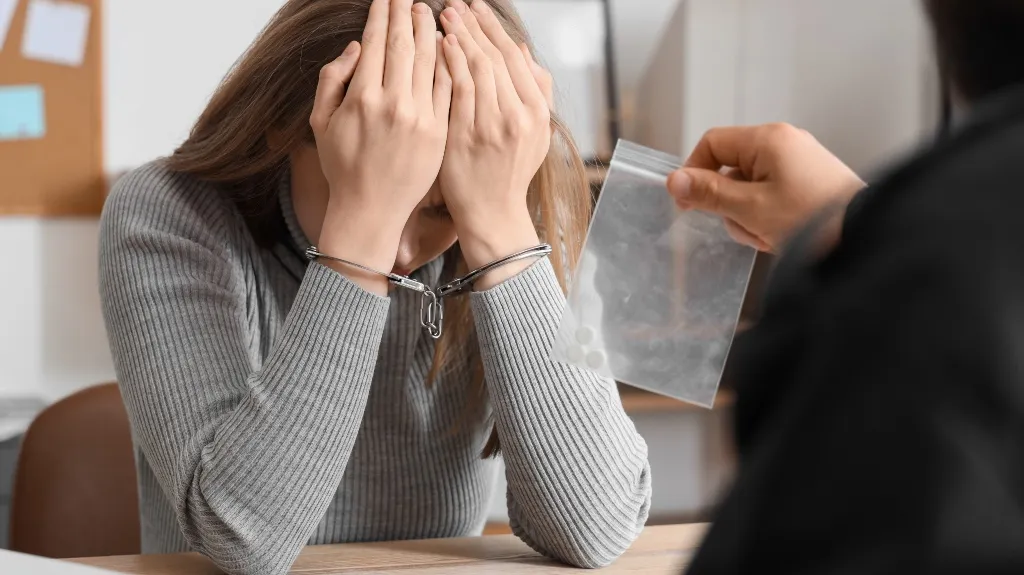
The common-sense reaction to a drug charge for something that wasn’t yours — drugs that belonged to someone else, or that were never in your hand or your pocket — is that it has to be a mistake. It often isn’t, at least not the way the law is written, and that surprises people: California can convict you of possessing a controlled substance you never touched, under a doctrine called constructive possession of drugs. But the same doctrine that makes that possible is also full of openings, because to use it the prosecution has to prove things about your knowledge and control that frequently aren’t true. If you’re facing a possession charge in Murrieta, Temecula, Menifee, Lake Elsinore, Wildomar, Winchester, Canyon Lake, or French Valley, the case will be heard at the Southwest Justice Center in Murrieta.
This page is about one specific question — whether you “possessed” the drugs at all. For the rest of what a possession charge involves (the penalties, whether it’s a misdemeanor or felony, diversion and how to avoid a conviction), see our drug crimes defense overview. What follows is the part that matters when your honest answer is “they weren’t mine.”
What Constructive Possession of Drugs Actually Means
Possession under California drug law doesn’t require the drug to be on your body. The law recognizes three forms. Actual possession is the drug in your hand, your pocket, your bag. Constructive possession is a drug somewhere you control even though it isn’t on you — a console in your car, a drawer in your home. Joint possession is when more than one person shares control of the same drug.
Constructive possession is the one that sweeps in people who never touched anything, and it rests on two requirements the prosecution must prove. First, knowledge — you knew the drug was there, and you knew it was a controlled substance. Second, dominion and control — you had the right to control it, by yourself or with others. Possession of a controlled substance under Health & Safety Code § 11350 (or § 11377 for methamphetamine) is not “the drug was near you.” It is knowledge plus control. Take either one away and the possession element fails — which is exactly where most of these cases are actually fought.
Being Near Drugs Is Not the Same as Possessing Them
The single most important principle in this area is also the one prosecutors most often blur: mere presence near drugs, and even knowing they’re there, is not possession. Being in a place where a controlled substance happens to be — a car, a room, a party — does not make it yours, and access alone is not control.
Think about how ordinary that situation is. You’re a passenger in a friend’s car and there’s something in his backpack on the back seat. You’re a guest in a home where your host keeps drugs in a kitchen drawer. You share an apartment, and a roommate’s drugs are in a common cabinet. In every one of those, you might know the drugs exist and still have no right to control them — and that gap is a complete defense, not a technicality. The law draws the line at control precisely so that being in the wrong place, or knowing the wrong person, isn’t a crime. When a case is built mostly on where you were standing, that’s a weak case wearing a strong face.
The Two Things the Prosecution Has to Prove — and How Each Is Challenged
Because constructive possession has two separate elements, it has two separate places to break. A defense doesn’t need both; defeating either one defeats the charge.
Knowledge has two parts, and each can be missing. You may not have known the drug was there at all — a substance tucked into a borrowed car, a shared space, or a bag that wasn’t yours can be genuinely unknown to you. Or you may have known something was there without knowing it was a controlled substance. The prosecution has to prove you knew both the presence and the nature of the drug, and what it usually has instead is an inference drawn from where you were — an inference that other facts can undercut.
Dominion and control is the second target. Knowing a drug is somewhere is not the same as having the right to control it. A passenger doesn’t control the contents of the driver’s bag; a houseguest doesn’t control the host’s drawers; one roommate doesn’t automatically control what’s in another’s room. Prosecutors try to bridge this with circumstantial evidence — your proximity to the drug, your access to the space, your statements, whether your personal belongings were nearby. Each of those is an inference, and each can be answered: proximity in a shared space cuts both ways, access isn’t control, and an ambiguous statement at a chaotic scene is not an admission. The work of the defense is to take the prosecution’s pile of “it was near him” and show what it doesn’t add up to.
Whose Drugs Are They? Shared Cars, Shared Homes, Someone Else’s Bag
Most constructive-possession cases come down to a “whose is it” fight, and a few patterns recur:
- A car with more than one person in it. Drugs found in a shared vehicle don’t belong to everyone in it. The question is who actually exercised control — and when several people had equal access, the prosecution often can’t prove that it was you rather than anyone else.
- A shared home or common area. Drugs in a kitchen, a living room, or a shared bathroom of a house with multiple occupants are not automatically attributable to any one resident. Whose room, whose container, and who had the right to control the space all matter.
- Someone else’s container. A backpack, a purse, a jacket, a locked box that isn’t yours — control of the container is usually control of what’s inside it, and that points away from you.
- A borrowed or rented car. People leave things in cars. A substance left by a previous driver or a borrower is not yours simply because you were behind the wheel when it was found.
There’s also a specific trap worth naming: the person whose drugs they really are sometimes tells the officer they’re yours, to deflect their own arrest. A self-serving accusation from someone with an obvious motive to lie is exactly the kind of evidence that doesn’t hold up under scrutiny — and recognizing it for what it is, early, is part of the defense.
When Briefly Touching Drugs Isn’t Possession
California also recognizes a narrow situation in which even physically handling a drug is not possession: brief, transitory handling for the limited purpose of getting rid of it or moving it away — picking something up only to throw it out, for instance. This is a real but tightly limited defense, and it should be treated with care, not as a script. Courts and prosecutors examine it closely, and it depends entirely on the specific facts and your actual purpose. Where the facts genuinely fit, though, it goes to the heart of whether you possessed the drug at all.
The Same Question Comes Up in Other Charges
“Did this person actually possess it?” isn’t unique to simple possession. The same knowledge-and-control analysis decides cases across the board, and where it leads depends on the charge. When the allegation is that drugs were held to sell rather than to use, the fight shifts to possession for sale, where the stakes are higher. When the allegation involves moving drugs, it becomes a question for drug transportation. And the identical doctrine governs firearm possession cases, where “constructive possession” of a gun in a car or a home is litigated the same way. The drug in front of you may be the immediate problem, but the underlying question — knowledge plus control — is the same one, and it’s worth getting right wherever it appears.
Charged With Someone Else’s Drugs in Southwest Riverside County?
If the drugs weren’t yours, that is not a hope you raise at the end of a case — it is the center of the case, and it is strongest when the facts about who controlled what are pinned down early, before memories harden and before a plea forecloses the argument. Possession cases in Murrieta, Temecula, Menifee, Lake Elsinore, Wildomar, Winchester, Canyon Lake, and French Valley are filed by the Riverside County District Attorney and heard at the Southwest Justice Center in Murrieta, and how the possession element gets litigated there is something learned by working in that courthouse.
If you’ve been charged with possessing a controlled substance that wasn’t yours, learn more about our office and our case results, and call the Law Office of Nic Cocis for a free, confidential consultation at (951) 400-4357.